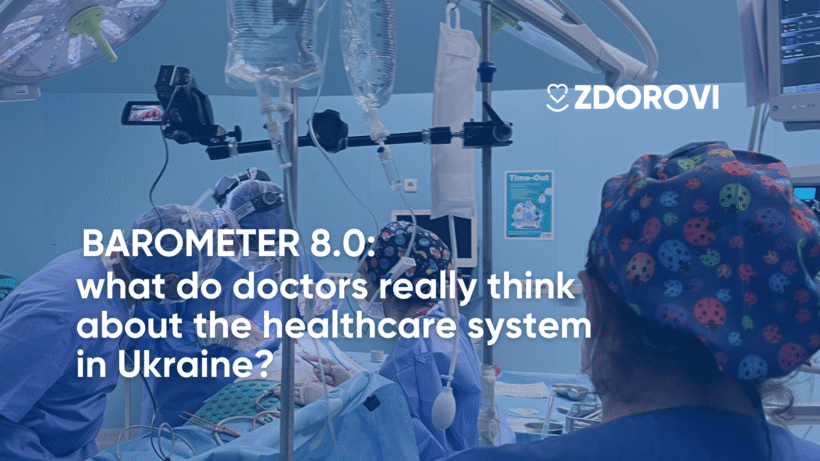
Every Ukrainian has sought medical help at least once in the past year. But what happens on the other side of the door? How do those who work daily in operating rooms, receive emergency patients in the ER, or take shifts at clinics actually feel?
The eighth wave of the Barometer survey, which ZDOROVI regularly conducts among medical executives, captures the real state of the system – an objective snapshot of how healthcare functions from the inside today.
Staff Shortages: Not Just Numbers, but Daily Overload
When more than 80% of respondents report a shortage of junior medical staff, and more than three-quarters point to a shortage of nurses, this represents more than a simple “staffing problem.” It means doctors are taking on some nursing duties, nurses are covering responsibilities typically assigned to orderlies, and many staff members are forced to do the work of two or even three people.
A shortage of doctors exceeding 60% would constitute a serious crisis in peacetime. In wartime, it multiplies the burden. Some specialists have been mobilized, some have left the country, others have moved to the private sector or changed professions due to burnout. And these processes are ongoing.
The key question is: if the system is already operating at full capacity, what will happen when demand for medical care increases further – for example, due to demographic changes or the accumulated post-war burden of chronic diseases?
Professional Burnout as The New Norm
Almost 8 out of 10 medical professionals report symptoms of professional burnout. Three-quarters indicate high levels of stress. These are not emotional impressions but a systemic characteristic of the profession in 2026.
It is important to understand that this is not just about fatigue. Burnout involves reduced empathy, emotional detachment, and cynicism as a defensive response. It’s when a doctor continues to work but distances themselves psychologically because, otherwise, they can’t cope.
For society, this means one thing: the quality of healthcare cannot be separated from the well-being of medical professionals. It is impossible to demand sensitivity and high standards of care while ignoring the psychological cost borne by healthcare staff.
At the same time, access to systemic psychological support remains limited. The paradox is that while the country actively discusses the mental health of veterans and civilians, medical professionals – one of the most psychologically burdened professional groups – often remain outside the focus of public policy.
Reform Through the Eyes of Those Implementing It
The study reveals a rather cautious attitude toward healthcare reform. While there are positive assessments, a significant share of respondents believe that a serious revision of current approaches is needed.
This is not a rejection of reform as such. Rather, it signals that a model designed in peacetime does not fully correspond to the realities of a wartime economy and the uneven distribution of workload across regions.
Medical professionals point to financial constraints, bureaucratic obstacles, and regulatory instability. At the same time, they acknowledge the advantages of reform – greater transparency, changes in financing mechanisms, and increased institutional autonomy.
This ambivalence is important. It suggests that the system does not resist change but expects adaptation. In essence, it is about the need to “reform the reform” – taking into account the war context, demographic trends, and the actual availability of human resources.
There Is Digitalization – but Transformation Is Almost Non-Existent
Electronic systems such as Helsi, eZdorovya, and eHealth have become commonplace in healthcare. Almost half of healthcare facility managers (49.1%) rate the level of digitalization as average, while another 35.1% assess it as high. At first glance, this appears to be a success.
However, only 2.6% report a very high level of digitalization – and this figure is crucial. It highlights the gap between the formal introduction of electronic tools and genuine digital transformation.
In most facilities, digital systems are used primarily to record data rather than as management tools. They facilitate reporting but rarely support analysis, forecasting, or resource optimization. Digitalization exists, but it has not yet changed the logic of decision-making – and without that shift, it is too early to speak of systemic efficiency.
Training: What Healthcare Professionals Need
One of the clearest signals from the study is the steady demand for training. This is not about individual courses, but about the system’s chronic need for new knowledge and upskilling.
Executives of healthcare institutions increasingly recognize that medicine can no longer be effectively managed by inertia. Key areas of training for management teams include strategic and operational management, financial planning, human resource management, energy management, and implementing principles of transparency and integrity. These competencies determine whether an institution can adapt to crises while continuing to develop.
For doctors, priorities remain updating clinical approaches, fostering interdisciplinary collaboration, working under increased workloads, and integrating digital tools into daily practice. This is not only about medical knowledge but also about the ability to operate effectively in a constantly changing system.
Nursing staff require practical skills, a greater role in the team, development of the service component, and effective communication with patients. This group is often overlooked in educational programs, yet the stable operation of healthcare institutions would be impossible without it.
The study makes one thing clear: Ukrainian healthcare relies not so much on the system itself as on the people who compensate for its shortcomings with their own responsibility, experience, and endurance. However, this resource is not unlimited. Without systematic, multi-level training, the risk of professional burnout and staff turnover will only continue to rise.
Transparency and Informal “Gratitude”
The issue of informal “gratitude” in healthcare has remained one of the most sensitive topics for society for years. In public discourse, it is often explained as tradition or mentality. However, the results of the 8th wave of the Barometer research suggest otherwise: managers of medical institutions clearly understand that informal payments are the result of systemic decisions – or the lack thereof.
Thus, 67.5% of surveyed managers consider a transparent system of staff remuneration and bonuses to be the most effective tool for preventing informal “gratitude.” Another 56.1% emphasize the importance of clear and accessible communication with patients about the free nature of medical services and official payment channels. A significant share of respondents also highlight the role of internal rules and procedures that limit opportunities for informal arrangements.
These figures indicate a fundamental shift in perspective: managers are increasingly less inclined to view “gratitude” as an ethical or individual issue. Instead, they recognize it as a management challenge requiring comprehensive solutions — from fair financial incentives for staff to building trust with patients.
In this context, transparency means not only the absence of informal payments, but also clearly defined rules for all parties. When healthcare professionals operate within a fair and predictable compensation system, and patients understand what services are free of charge, the room for corruption is significantly reduced.
Energy Efficiency: A Problem Everyone Is Talking About?
In winter conditions – and amid regular attacks by russian federation on energy infrastructure – the issue of energy efficiency in medical facilities is shifting from modernization to operational continuity.
Research data show limited consistency in this area. Only 23.7% of executives rate the energy efficiency of their facilities as high or very high, while 53.5% describe it as “average.” At the same time, just 21.9% of facilities conducted an energy audit in 2025.
This suggests that, for a significant number of hospitals, energy sustainability is not yet integrated into the management model. Isolated solutions prevail – thermal insulation (55.3%), energy-efficient lighting (54.4%), and internal educational activities (58.8%) – while systematic energy management and comprehensive investment approaches remain less common.
In reality, amid prolonged power outages and the risk of repeated damage to energy infrastructure, this creates structural vulnerability. Without a stable power supply, it is impossible to ensure the full operation of operating rooms, laboratories, medication storage systems, and intensive care units.
European Integration: Everyone Supports It, but Not Everyone Is Ready
In public discourse, European integration is often presented as a political direction or an abstract ambition. For healthcare institutions, however, it is a tangible and demanding transformation – involving new management standards, a different culture of accountability, and higher expectations for quality and transparency.
While most institutions express support for European integration, their actual readiness varies significantly. The main obstacles are not opposition to change, but limited resources, time constraints, and insufficiently trained personnel.
For healthcare facility managers, European integration primarily means stricter governance requirements: strategic planning, transparent financial management, robust internal control systems, effective data use, and accountability for measurable results. This transforms the executive’s role from administrator to leader of change.
For medical professionals, it entails adherence to higher standards of quality and patient safety, stronger interdisciplinary collaboration, and continuous evaluation of performance. Without systematic and ongoing training, these new standards risk remaining formal rather than substantive.
Ultimately, European integration in healthcare is not just about alignment with policies – it is about building institutional capacity so that hospitals can function as autonomous, responsible entities capable of planning development, managing risks, and using resources efficiently.
War as an Amplifier, Not a Root Cause
It is important to be honest: most of today’s problems did not emerge in 2022. The war exposed and intensified them. Chronic underfunding, inequality between urban and rural areas, and workforce imbalances all existed before. The war added new layers of pressure: wounded soldiers, complex trauma cases, rising mental health needs, and large-scale population displacement.
The system withstood the initial shock. The question now is whether it can endure a prolonged period of “slow exhaustion” if structural solutions are not implemented.
Why is it so important to conduct this kind of research?
The ZDOROVI Barometer study is not merely an internal reflection of the medical community – it concerns the safety and well-being of every citizen.
If doctors are collectively exhausted, if young professionals see no future in the system, if growing workloads are sustained only by personal dedication, then healthcare is being upheld by moral resilience rather than institutional stability.
For the state, this signals the need for a strategic workforce policy. For healthcare executives, it requires a reassessment of work organization and resource allocation. For society, it demands recognition that the call for “quality healthcare” is inseparable from investment in the people who deliver it.
For international partners, the study’s findings highlight clear areas where support can generate systemic impact.
- First, infrastructure and energy security.
- Second, technical capacity.
- Third, management capacity and transparency.
Support focused on infrastructure, technology, and governance, therefore, has the potential not only to address immediate crisis needs but also to strengthen the healthcare system in the long term amid a protracted war.
The main value of the study lies in the fact that it neither dramatizes nor embellishes. It captures the condition of the system at a specific moment in time. And that condition can best be described as stability on the brink.
Ukrainian healthcare has demonstrated its ability to function under extreme pressure. The key question now is whether the state can transform this heroic resilience into systemic stability – because the resource of heroism is always finite.
The research was conducted with the support of the Askold and Dir Fund as a part of the Strong Civil Society of Ukraine – a Driver Towards Reforms and Democracy Project, implemented by ISAR Ednannia and funded by Norway and Sweden.